Super Beetle Articles and Technical Guides
The Sports Bug
With its unique aesthetic enhancements and sporty touches, the Sports Bug
offered more of a spirited take on the beloved 'Peoples Car,' albeit in
limited numbers. This is the story of this iconic special edition Super
Beetle.

Of all the Special Edition Beetles, the 1973 Sports Bug stands out as a
fan favorite, exclusively available as a Super Beetle. It boasted a unique
paint finish, black bumpers, black exterior trim, a rear window defroster,
and a leather sports steering wheel handcrafted by Petri AG. Buyers could
choose between two exterior colors: L13M Saturn Yellow and Marathon Blue
Metallic, both complemented by a Schwarz cloth interior.

The Sports Bug, along with its counterpart, the GSR (Gelbschwarzer Renner
or Yellow Black Racer), was unique for being the only Special Edition Beetles
equipped with 5 1/2" Lemmerz "GT" Sports Wheels with an ET26
offset. To support this launch, VW dealerships showcased a variety of themed
optional accessories, enhancing showroom displays. These included a striking
US-designed red and black 'waist' stripe, anodized matte black trim pieces
like, vent grill trim, a four-piece engine lid vent grill set, front and
rear gravel guards, exhaust tailpipes, and black plastic headlamp surrounds
produced for VWoA by Production Plastics of Michigan.

Sales brochures depicted the Sports Bug Edition with black headlight surrounds,
as seen in the initial shipment. However, most of these special editions
were delivered with standard chrome headlight surrounds, which explains
why nearly all promotional photographs feature the chrome version. Volkswagen
of America heavily promoted the Sports Bug, utilizing American-produced
sales literature, national magazine advertisements proclaiming "Volkswagen
announces a limited edition Volkswagen," and extensive television commercials
urging viewers, "If you don't get it now, you might not be able to
get it at all."

The sales brochure was an intriguing little folder that unfolded to showcase
two Sports Bugs, surrounded by vibrant cartoon characters playfully commenting
on the vehicles. This creative design was crafted by Jack Davis, who is
widely recognized for his significant contributions to comic art in MAD
magazine. The text playfully hinted: "Every now and then, we let our
imaginations run wild and release a limited edition of a truly fun car.
This is one of those special moments… We produced a small batch, and
then, quite literally, we broke the mold. So if you're interested, let us
know. Like, right now?"

Additionally, the brochure invited potential buyers to "Go all out
and customize your Sports Bug with these sleek black metal trim options…
bumper over riders, door handle shields, gravel guards, rear hood grille,
and flare-tip exhaust extensions." Volkswagen only manufactured 20,000
Sports Bugs within the "Rallye" Group of Special Edition Beetles,
making this a very rare and sought after Special Edition Super Beetle.
Epilogue - The Last Special Edition Super Beetle
The 1970s marked the launch of Special Edition Beetles, introducing models
like the Sports Bug, Sun Bug, Love Bug, Fun Bug, Winter Bug, La Grande Bug,
and Champagne Bug, along with international variants such as the Jeans Bug
and Big and City models. A notable release was the Jubilee Beetle, which
celebrated Volkswagen's milestone of over twenty million sales globally.

This edition was among the first to be based on both the standard Beetle
and the 1302 Super Beetle, paving the way for more than 35 additional special
editions, with many more produced in Mexico. In 1971, the standard Beetle
convertible was discontinued, and from then until early 1980, all convertibles
manufactured were of the Super Beetle type. The final special edition of
the Beetle was aptly named the Epilogue Convertible, often referred to as
the "Triple Black."

This
unique model showcased a sleek black exterior, complemented by a matching
interior and top. The Epilog celebrated the connection to the original Kdf-Wagen
convertibles produced at the Karmann plant four decades earlier, which were
also finished in black. Priced at $7,140, the 1979 Super Beetle convertible
could be ordered with the special black paint, which came with an additional
charge of $200 and included an AM/FM radio.

The vehicle showcased a sleek black exterior paired with black basket weave
seats, creating a striking triple black look. Like all US convertibles produced
from 1979 onward, the Epilogue came equipped with 165SR15 whitewall radial
tires, Lemmerz GT Sport wheels, a cigarette lighter, a quartz crystal clock,
dual outside mirrors, a heated rear window, a leatherette sport steering
wheel, and wood grain dash accents as standard features. Notably, the final
Epilogue convertible was built four days after the last official convertible
rolled off the Karmann production line in Osnabruck on January 10, 1980.
Spot a Super in Seconds
At first sight, Super Beetles may appear similar to regular Beetles, but
there are actually several differences that set them apart. Here are a few
key distinctions between Volkswagen Super Beetles and standard Beetles,
along with tips on how to tell if yours is a Super or a Standard model.

A key distinction between the Standard Beetle and the Super Beetle lies
in their suspension systems. The Super Beetle features a MacPherson front
suspension, in contrast to the traditional torsion beam found in the Standard
model. If you know what to observe, identifying this difference is straightforward;
just kneel beside a Super Beetle, and you'll notice the visible springs.

The trunk space in a Super Beetle is more spacious compared to a Standard
Beetle, resulting in a bigger opening around the spare tire. This design
provides an additional 3 cubic feet of storage for your luggage. So, if
you can easily stash your groceries and other items alongside the spare
tire, chances are you're driving a Super Beetle.

While not all Super Beetles came with a curved windshield, it's a noticeable
difference when you place two Beetles next to each other. The curved windshield
also brought about a new dashboard design, which was unique to the 1973
Supers. Volkswagen aimed to set these Super Beetles apart from earlier models,
even if most people at the time might not have recognized the distinction.

You can also identify your car by checking the dashboard and windshield.
If your windshield has a curve and the dashboard is padded, you not only
own a Super Beetle, but it's specifically a 1973 model or newer. Another
method, which requires a bit more effort, is to measure the car's length
and width to determine if it's a Standard or Super Beetle.

So how do you spot a Super in seconds? Take a look for springs behind the
tire located under the front fender. If you find springs, congratulations,
you have spotted a Super Beetle! It's as straightforward as that.
Book Review: Ugly Is Only Skin-deep
The Volkswagen Beetle became an icon not just because of German engineering,
but also due to the efforts of a Manhattan advertising agency. Established
in 1959 by Doyle Dane Bernbach and carried on into the ’60s and early
’70s, the campaign for the Volkswagen Beetle is widely regarded as the
greatest of all time.

It didn't just market a car, but also introduced a new style of advertising:
one that was simple, charming, intelligent, and above all, honest. In his
book "Ugly Is Only Skin-deep," Dominik Imseng delves into the origins
of Doyle Dane Bernbach, which faced disdain from major players on Madison
Avenue because of the "ethnic" background of its founders and staff,
who were predominantly Jewish.

The narrative then unfolds to reveal how the agency secured the Volkswagen
account and how an unlikely duo of creatives—copywriter Julian Koenig
and art director Helmut Krone—shaped the direction of the most revered
advertising campaign in history. Chapter 7: Will we ever kill the bug? In
what was to become an unforgettable shoot, a brand new VW was borrowed from
a local VW dealer and suspended from crane so that it could be gently lowered
and set down on its roof (like a dead bug). DDB Art Director Len Sirowitz
remembers, "The afternoon light was beautiful.

The photographer, with his camera on a tripod in a locked position, was
ready to shoot. And then it happened: in a split second after the car had
touched the ground, its roof collapsed. Fortunately, the camera had already
clicked off two shots, before we had to get up enough nerve to return the
damaged car to the very unhappy Volkswagen dealer." The book also explores
the progression of the Volkswagen campaign and how advertising luminaries
like Bob Levenson, Len Sirowitz, Roy Grace, and Bob Kuperman succeeded in
persuading more and more Americans that smaller was indeed better.
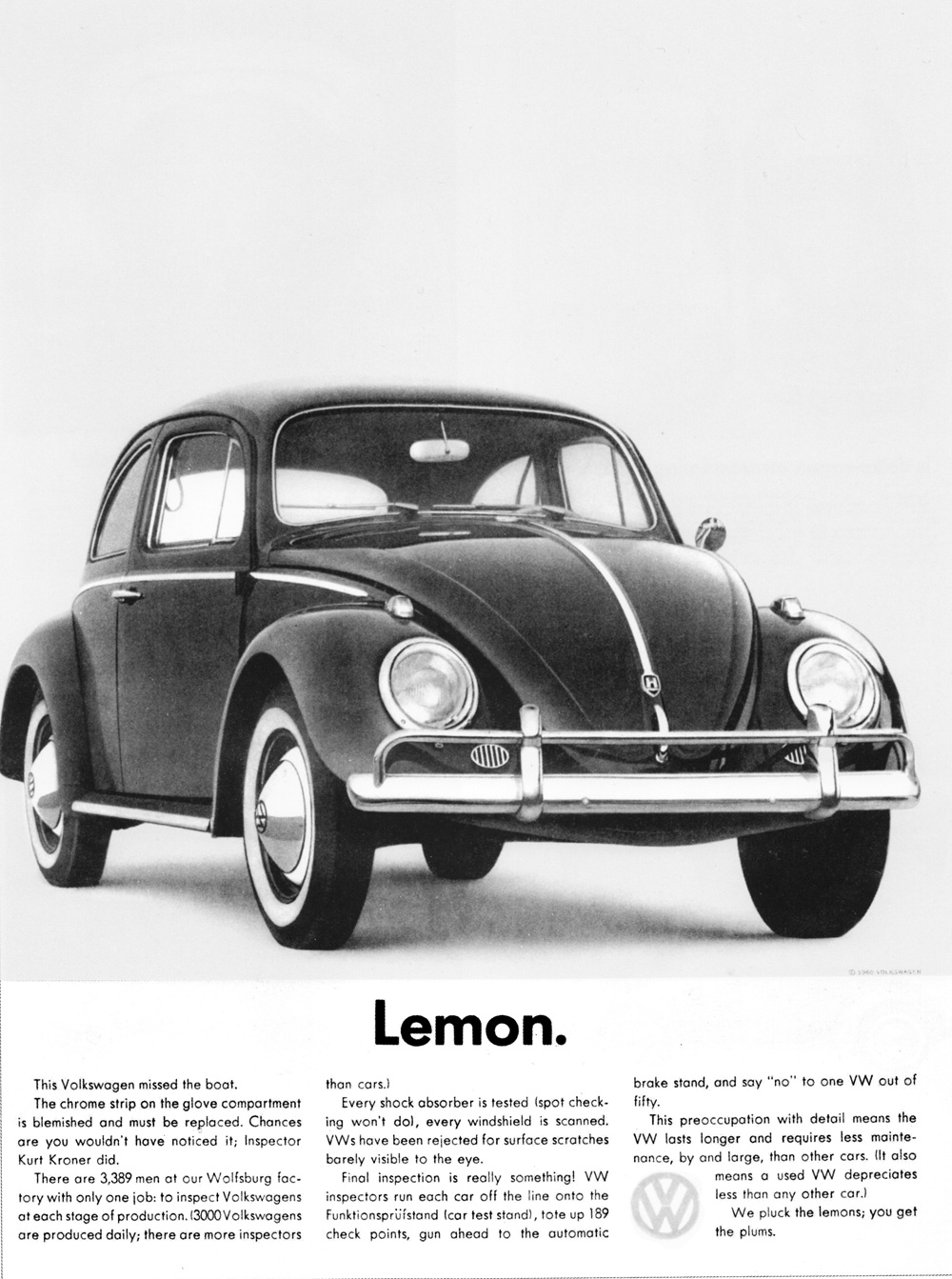
Not only did the Volkswagen campaign revolutionize the advertising industry,
but it also played a role in sparking the cultural transformation of the
1960s. Although the book does not cover any Super Beetles ads, author Dominik
has told me that the next release of Ugly Is Only Skin-deep will delve into
1302/1303 ads created by DDB. Highly recommended if you're a fan of these
icon Volkswagen ads. More info at https://dominikimseng.com/the-history-of-those-great-volkswagen-ads/
What is MacPherson Strut Suspension?
The MacPherson strut, commonly found in the front suspension of modern
vehicles, utilizes the top of a telescopic damper as the upper steering
pivot. This type of automotive suspension system was created by American
automotive engineer Earle S. MacPherson. In 1945, Earle S. MacPherson became
the chief engineer for Chevrolet's Light Car project, aiming to create a
new compact car for the postwar market, resulting in the Chevrolet Cadet.

The Chevrolet Cadet was set to introduce innovative features, including
a pioneering independent suspension system with a MacPherson strut, showcased
in the three prototypes developed by 1946. Despite its potential, the Cadet
project was terminated in 1947 before reaching commercial production, mainly
due to General Motors' apprehensions regarding the projected profitability
of the vehicle.

The French 1949 Ford Vedette is commonly misattributed as the first production
car to utilize MacPherson struts, but it actually featured an independent
front suspension with wishbones and an upper coil spring prior to MacPherson's
design. It wasn't until 1954, following Simca's acquisition of the Vedette
factory, that the updated Simca Vedette adopted front struts. The MacPherson
strut utilizes a wishbone or a compression link, along with a secondary
link, to stabilize and provide a mounting point for the wheel's hub carrier
or axle. This system allows for both lateral and longitudinal positioning
of the wheel. The upper part of the hub carrier is firmly attached to the
bottom of the outer part of the strut, which slides up and down the inner
part.

The inner part extends directly upwards and is mounted in the vehicle's
body shell. The steering axis inclination is determined by the line connecting
the top mount of the strut to the bottom ball joint on the control arm.
To ensure clearance for the tire, the strut's axis may be angled inward
from the steering axis at the bottom, causing the bottom to follow an arc
when steering. The introduction of unibody construction greatly benefited
the MacPherson strut due to its need for vertical space and a strong top
mount, both of which are provided by unibody construction. Additionally,
unibody construction helps distribute suspension stresses. The MacPherson
strut typically carries both the coil spring and the shock absorber, which
is often in the form of a cartridge mounted within the strut. It can also
have the steering arm integrated into its lower outer portion.

This entire assembly is simple and can be pre-assembled as a unit. Removing
the upper control arm allows for more engine compartment width, which is
advantageous for smaller cars, especially those with transverse-mounted
engines commonly found in front-wheel drive vehicles. If necessary, the
assembly can be further simplified by substituting an anti-roll bar for
the radius arm. These factors have made the MacPherson strut popular among
low-cost manufacturers and it also provides an easy way to set suspension
geometry. While Standard Beetles were designed to use torsion bars, all
Super Beetles were upgraded to the Macpherson strut and coil spring setup.
This big change increased the driving quality and improved the Volkswagen
Beetle's poor turning radius. The accuracy of the steering and this smoother
ride can easily be detected by taking both Beetles for a road test. All
images courtesy of Top
Line Parts, your Super Beetle suspension specialist.
What Makes a Super Beetle a Super Beetle?
The Super Beetle stood apart from the standard Beetle due to several key differences.
One of the main differentiating factors was the MacPherson strut independent
front suspension, which Volkswagen specifically engineered for this model.
While Volkswagen never officially disclosed the exact reasons behind introduction
of the 1302 and then the 1303 Super Beetle, it is widely believed that safety
considerations played a significant role.

To accommodate the new front suspension, Volkswagen had to make certain
modifications. They lengthened the wheelbase by approximately 0.8 inches
and extended the hood and front sheet metal by around 3.2 inches. These
changes may not be immediately noticeable from a side profile view, but
if you examine the front trunk (hood or bonnet), you'll notice that it is
broader and flatter at the leading edge compared to the standard Beetles
V-shaped leading edges.

Additionally, Super Beetles featured a slotted front apron under the front
bumper, while all sedans, both regular and Super, received narrow crescent-moon-shaped
vents just behind the rear windows in 1971. The increased space provided
by the MacPherson strut IFS allowed for a larger trunk and a lay-flat spare
tire, as opposed to the more upright spare tire found in Standard Beetles.
It's worth noting that the Super Beetle name was exclusively used for North
American models equipped with the MacPherson-strut IFS.

European models underwent the same changes but were sold under the 1302/1303
model names. Further changes occurred on an almost yearly basis. In 1972,
the Super Beetle received a taller rear window. In 1973, all Beetles were
equipped with a curved windshield, a deeper dashboard, "elephant's foot"
tail lamps, and an alternator instead of a generator. By 1975, all Beetles
were fitted with electronic fuel injection and rack-and-pinion steering.

Throughout the Super Beetle's production, numerous minor changes were implemented,
ranging from redesigned front seats to the addition of fender beading. The
Super Beetle sedan was produced from 1971 to 1975 with the Super Beetle
convertible continuing on until 1979, while the standard Beetle sedan remained
in production until 1977.
Interview with Jon Chabot - Owner of Top Line Parts
SB: When did you originally get into Volkswagens?
Jon: My father bought his first VW in 1958. He had to wait for the
delivery from one of those little dealerships that they had at that time.
When they called him on the phone they said: "We have two cars available,
a black one and a blue one." Dad chose the blue one! Years later when
Dad upgraded to a '66 1300 model, I sold my MG Midget and got the Beetle
from Dad.

SB: Do you own or have you owned a vintage Volkswagen?
Jon: Well, I drove that '58 to college for a few years, then upgraded
to the '66 1300cc. I hot-rodded it a little bit with the help on a nice
German man named Karl at Don Burns dealership. It had a Revmaster 22 cam,
a header, and a Bosch 010 distributor. We've had a lot of VWs in the family,
but currently I only have a '67 Baja Bug, and a '72 Super Beetle at the
body shop.

SB: What's your oldest Volkswagen memory?
Jon: I think abound 1960 or so, my family planned a camping trip to
Doheny Beach. Dad had a large roof rack (previously on his 1950 Ford), and
we filled that up with all our camping gear. So my Dad, Mom, my Sister and
myself piled into the bug for a week long beach camp out. I remember it being
really a lot of fun. We met some surfers there and tried to surf a little!
SB: When did Top Line Parts open and where are you located?
Jon: Top Line Parts opened in 1979, but previous to that I had a
little retail store in Anaheim, Calif. called Street Scene. Top Line has
been at the same general location from our opening to current times. We've
been in pretty much every unit in the building complex, but now we've downsized
and are in with a company Called 928 International. They sell Porsche parts
for the 928 model. Previous to this we had a fairly busy service shop in
the front of the building. Our current address is 2900 E. Miraloma Ave,
Unit D, Anaheim, Calif. 92806.

SB: Why did you decide to specialize in Super Beetle suspension?
Jon: I think it was around 1979 or so, when I still had my Street
Scene store, and Top
Line Parts was just starting up. My good friend John Dean came into
the shop to discuss how to lower his '73 Super. We came up with a plan to
use the strut inserts from the '74 and later Super, because they were shorter.
The strut bodies had to be double sectioned to make them fit the inserts.
John's brother Gearhardt did the fabricating. The spring holder was lowered
three inches, and the top side adjusted to fit the shorter insert. That
'73 Super show car went on to be the first Super Beetle ever to win best
of show at a VW event! The paint color was an outrageous Porsche Raspberry.
It was at the Sacramento Bugorama. My '62 Standard Beetle Cal-Look also
got a trophy!
SB: What was the first suspension product that you came
up with?
Jon: That would be the Super Beetle lowering strut. We had been modifying
customers struts for some time by cutting and welding. We got tired of that,
and decided to make a strut tube from all new materials. The amount of drop
was fixed. We had two inch, three inch, and four inch models. It wasn't
until a few years later that we started making the snap ring adjustable
models.

SB: What is your current best seller?
Jon: Well, that depends on if you are talking about the number of
items sold, or the dollar volume. Believe it or not, my current best seller
(number-wise) is the Power Pedal gas pedal. We have three different models
now! If you are talking dollar amounts, that would be the MaXX lowering
struts. That's the one with the small diameter spring. It allows big "German
Look" wide rims to be installed. The Super Low Pro kit is a good seller
too.
SB: What would you say is the coolest or most unique product
that you have introduced?
Jon: That would have to be the Camber+ kit for the Super. It allows
extra camber adjustment for lowered and modified cars. It also includes
black heavy duty urethane bushings to improve the steering. I had been trying
to think up some device to do the job for several years. One morning, as
I was waking up, the idea for how to make it came to me. That's actually
when I get many of my ideas.

SB: Are you working on something new for the Super Beetle?
Jon: There's always something in the back of my head, but nothing
Super specific is coming up soon. I did recently introduce laser cut cylinder
base spacers for bigger engines. Now that the folks that used to make them
aren't around anymore, there's a need for them. I'm currently expanding
the sizes and thickness of the spacers so that in most cases the they don't
have to be custom ground.
SB: How many people work with you?
Jon: Well, when I downsized a couple of years ago, we closed the
service portion of the business. Now that it's mostly mail order, I don't
need much help. It's myself, my son, and my wife. I still take all of the
phone calls, so when someone answers, it will be me!

SB: Where is the farthest place you've ever shipped your
products?
Jon: I'd have to get out my world atlas to be sure, but I'm pretty
sure that would be Australia. Australians got the Super Beetle models just
like we did in the USA. I just shipped an order to South Africa. How far
is that?
SB: What are your future plans for Top Line Parts?
Jon: I'm seventy seven years old now, so it may be time to think
about retirement soon. I'd really like someone to take the helm and keep
making my products to their current quality level. That would make me happy.